The Cretaceous period had a relatively warm climate that allowed the earth to be abundant with life. New groups of mammals and birds appeared, but dinosaurs still dominated on land. Along with many other dinosaurs the Tyrannosaurus Rex, Triceratops, Einiosaurs, Hadrosaurs, Pterosaurs, Velociraptor, and the Brachyceratops all lived during this period. The end of the Cretaceous was marked by a mass extinction that erased dinosaurs from the earth. It is believed that that this extinction was triggered by a comet/asteroid impact on earth that had catastrophic affects on the global environment.
The Sarcosuchus is known as a “Super Croc” and lived 112 million years ago. It is a relative of the modern crocodile only much larger. The maximum body length was estimated at 36 to 39 ft. and the weight was approximately 8 tons.
The Triceratops was a herbivorous dinosaur that traveled in family groups. Triceratops means “three-horned face”. These creatures are characterized by the three horns on their skull and the large frill at the back of the skull.
Psittacosaur lived between 140-99 million years ago in Asia. Our Psittacosaur is a full grown adult.
In this case we have a fossilized cockroach and grasshopper dated to 90 million years ago. This proves that these creatures have been around for a very long time and have evolved very little from their early ancestors.
In this diorama there is a model of a Hyphalosaurus. In the case is an actual fossilized Hyphalosaurus. These were aquatic reptiles that lived during the early Cretaceous period.
Here are a few different Triceratops bones. We have a tendon and tooth with the root from a Triceratops. We also have fossilized leaves found near a Triceratops in the Hell Creek formation in Montana. This helps us to know what the environment was like for these creatures, and what they may have eaten. From this information we are able to make the diorama look as close to the actual environment as possible.
In the next cases are various teeth from different dinosaurs. By looking at the teeth we can tell if a dinosaur was a carnivore or herbivore.
The skulls that we have here are from an Allosaurus, a Raptor, and a Pachycephalosaurus. The Allosaurus is a theropod dinosaur that lived during the late Jurassic Period. It is similar to the Tyrannosaurus Rex, however, not as large. The Pachycephalosaurus was a dinosaur that had a large, hard, bony dome on top of its skull. When the Pachycephalosaurus would encounter the T-Rex it could ram its skull into the side of the T-Rex and possibly break its ribs, giving it time to escape.
Plesiosaur, Ichthyosaur, Mosasaur, Brachyceratops & Meteorite
The Plesiosaur was a marine reptile from the cretaceous period. In the mural you can see an illustration of a Plesiosaur and above the Gem room is a replica of the skeleton of a Plesiosaur. In the cases are fossilized bones of the Plesiosaur.
The Ichthyosaur is another marine reptile that lived during this time. It is represented in the mural on the wall. In the cases we have fossilized bones from this creature. Ichthyosaurs resemble dolphins and were the dominant aquatic predator until they were replaced by the Plesiosaurs.
The Mosasaur became the dominant ocean predator at the end of the Cretaceous after the extinction of the Ichthyosaurs and the decline of the Plesiosaurs. The Mosasaur represented in the mural on the wall and above the Gem room is a model skeleton of the Mosasaur. In the case we also have fossilized bones from a Mosasaur.
The Brachyceratops lived during the Cretaceous and is similar to the Triceratops. Only juvenile specimens have been found which limits the knowledge we have about these creatures.
It is believed that what ended the Cretaceous period and the Dinosaurs was a meteorite hitting the earth. This caused severe consequences on the atmosphere. The Chicxulub crater found in Mexico is thought to be the impact site of the enormous meteorite. The collision caused an impact winter that destroyed most plant life, which then led to the extinction of many dinosaurs due to a lack of a food supply. The meteorite we have here is similar to the one that hit the earth millions of years ago only much smaller.
The real meteorite here weighs 9 pounds and the model we have is an exact replica of the real one in the case.
Einiosaur & Tyrannosaurus Rex
Most fossils that we find in Texas come from the Cretaceous period. In the next few cases there are fossils that have been found in Texas dating back to the Cretaceous period. Gastropods are a common fossil found here from the Cretaceous, as well as many shells and coral. Remember most of these fossils are from the Ocean because Texas was covered by water during the Cretaceous.
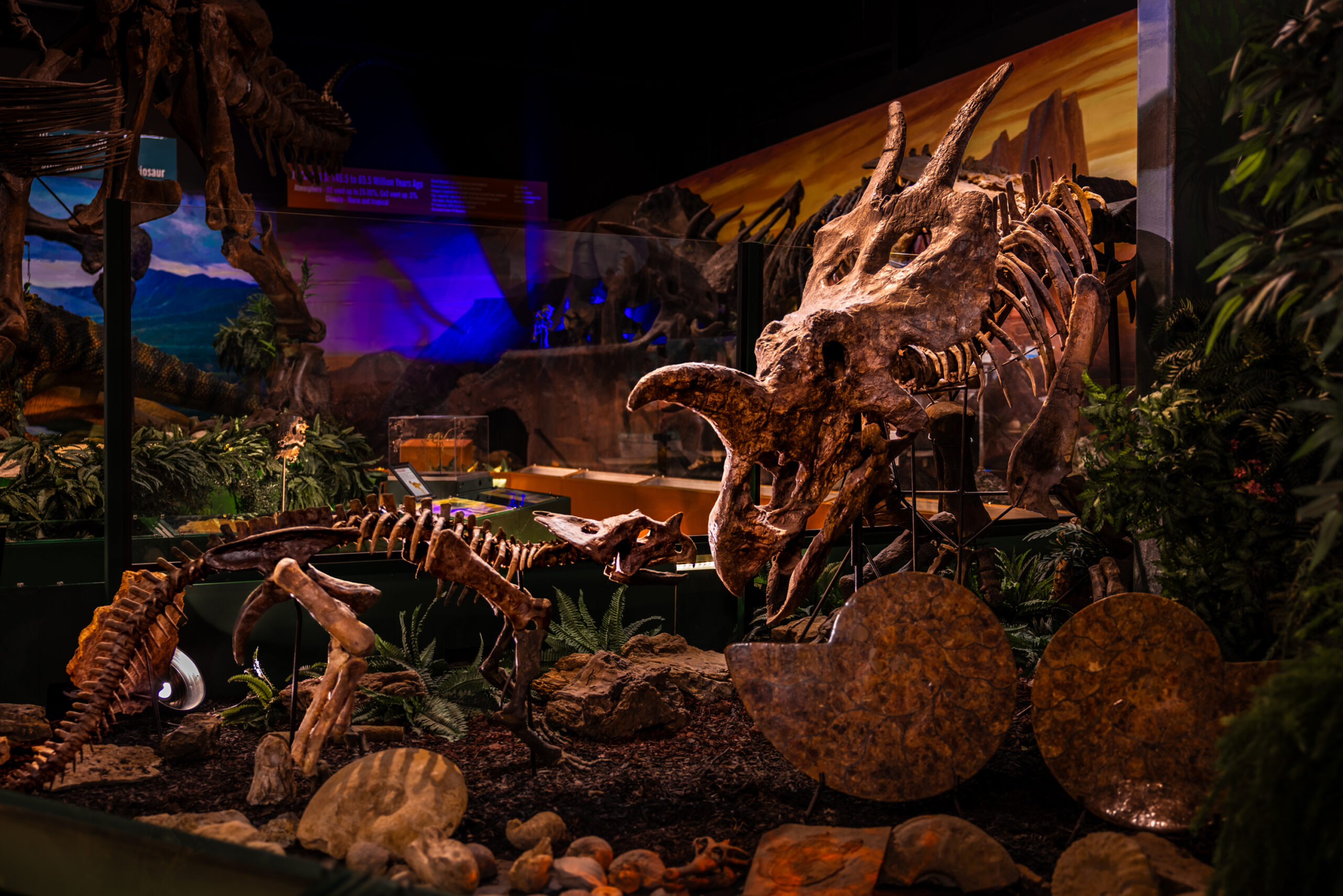
Here we have Mommy and Baby Einiosaurs! Einiosaurs resemble the Triceratops, but the horn on their snout curves the opposite direction. They had spikes that stuck out from their frill. They were herbivores and probably lived in herds. We think that the Mommy died protecting her baby. These fossil skeletons are virtually complete.
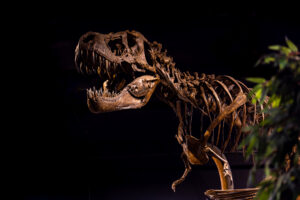
The Tyrannosaurus Rex was the top predator during the Cretaceous period. He was a carnivorous dinosaur that preyed on just about all the other dinosaurs. His name means “Tyrant-Lizard King”. He was the tyrant and king of the land during this time.
In this case is a bone from a Hadrosaur that has teeth marks in it. This dinosaur was probably eaten by a T-Rex. The tooth of the T-Rex was very sharp and you can see how easy it could rip through the flesh of the other dinosaurs.
In this case we have a T-Rex vertebrate, rib, and a cast of the brain of this creature. The brain is fairly small in relation to the size of “Bubba Rex”. He was nearly 40 ft. long, 12 ft. at the hips, and weighed 14,000 lbs.
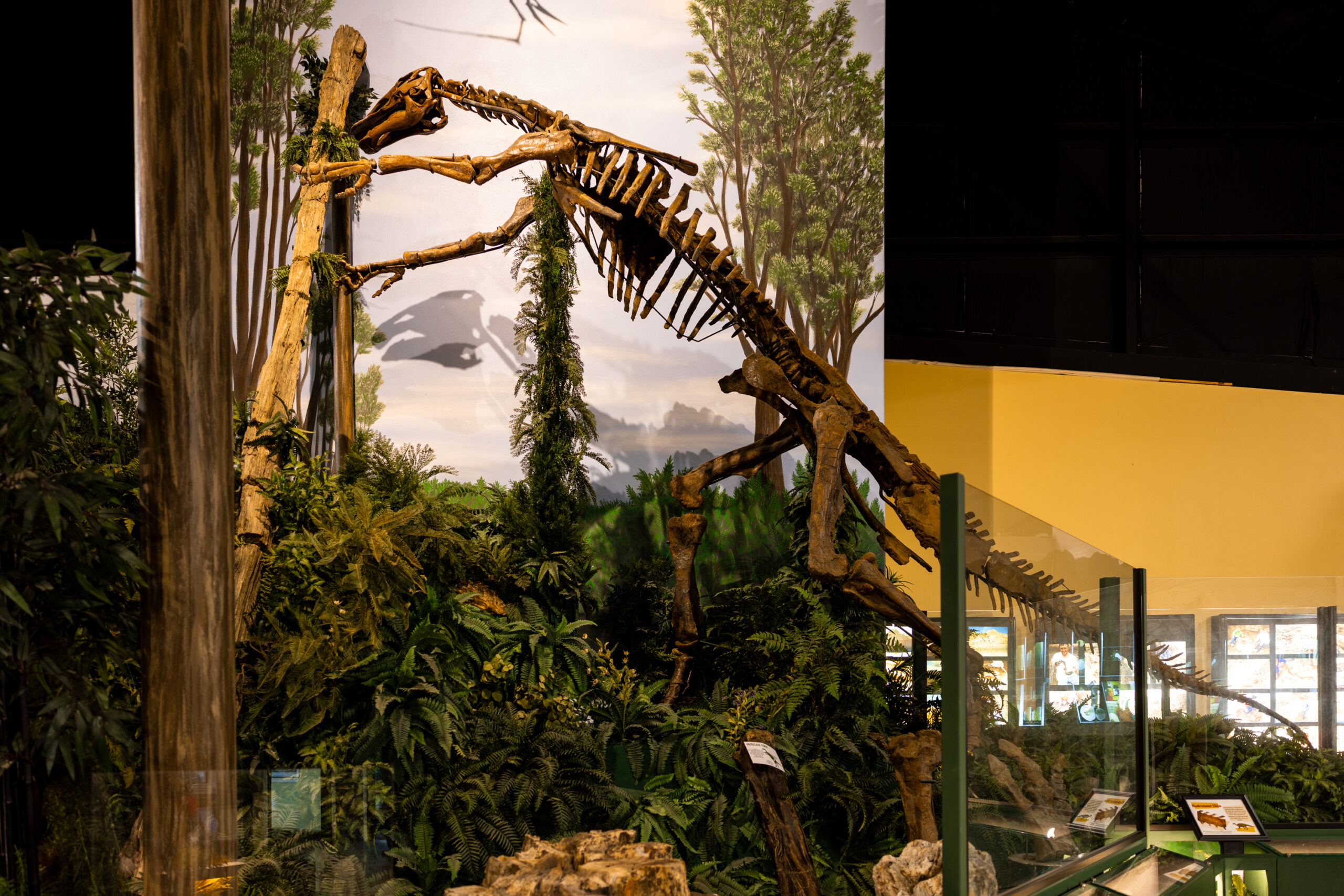
Mary Ann Hadrosaur
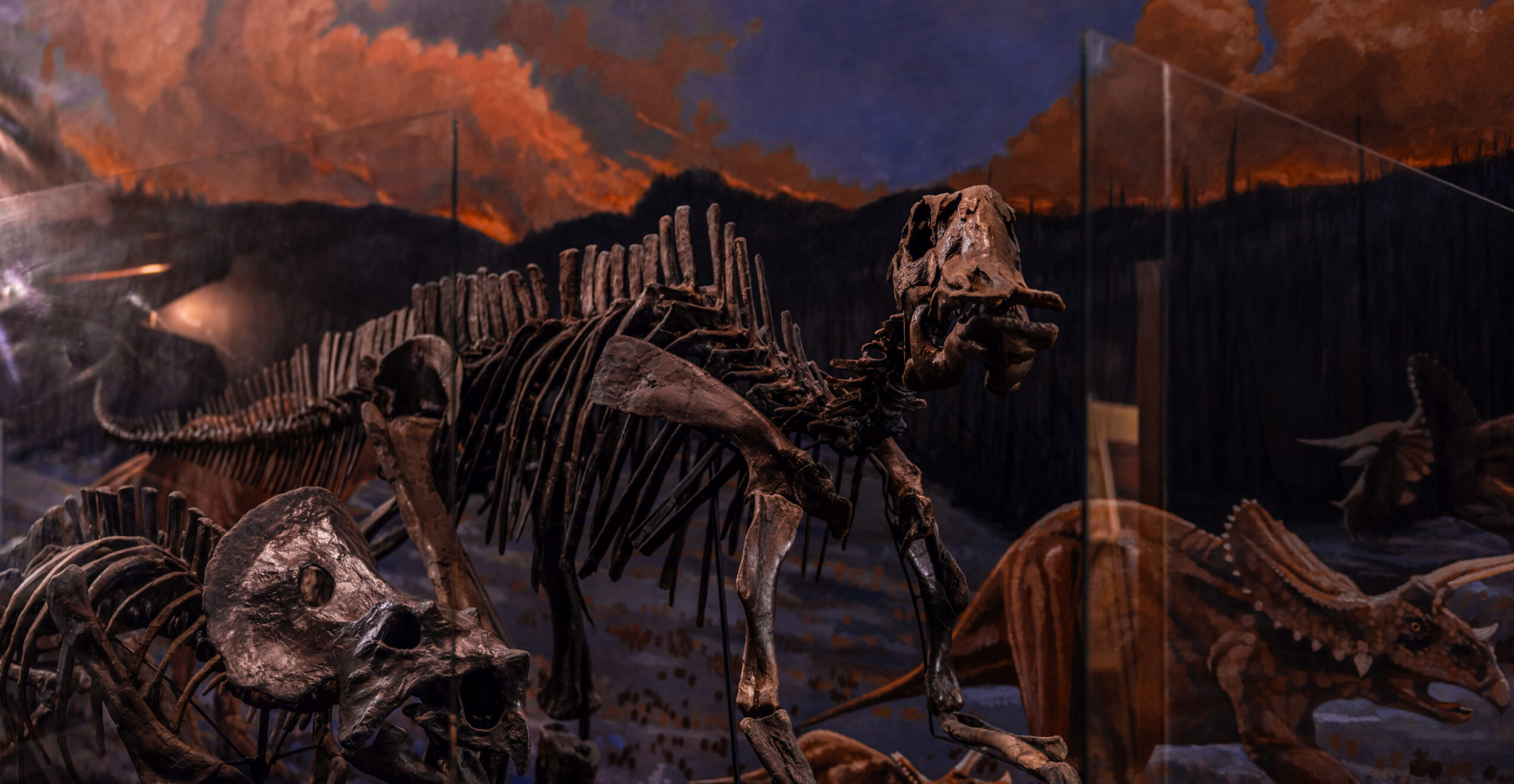
Mary Ann Hadrosaur was found in the Hell Creek Formation of Montana by the Naranjo expedition in 2008. She lived 68 million years ago in a swampy environment. Hadrosaurs were known as duck-billed dinosaurs and were herbivores. Mary Ann is very well preserved. If you look down her back you can see tendons that were fossilized along with some impressions of her skin. Her foot is a very detailed and a great example of her skin impressions. From her we can tell what the skin and tendons of a hadrosaur probably looked like. She is the first Hadrosaur found with her hooves. Mary Ann Hadrosaur is 26 ft. long.
The reason we know that Mary Ann lived in a swampy environment is because of the fossils that we found near her. Fossilized pine cones were found near her. Leaves, fly larva, and petrified wood all gave us clues as to what environment she lived in. There is also a piece of chewed wood that she could have been possibly chewing before her death. All of these things help us to know the environment that she was in when she died.
Here you can see pictures from Montana when Dr. Neal found Mary Ann Hadrosaur. You can see where he found her foot and how intact it was.
These are fossilized bones from a Thescelosaurus. They lived in the very late cretaceous period right before the extinction event. They were bipedal herbivores with small arms and a long tail.
These fossilized bones come from a Therizinosaurus, meaning “scythe lizard”. This dinosaur was fairly large and lived during the late cretaceous. It was known for its long gigantic hand claws, the longest of any other dinosaur. Even though they have these long claws they were probably herbivorous.
If you look up you can see one of the largest flying animals of all time. The Quetzalcoatl was a pterosaur from the late cretaceous period. It was as tall as a giraffe and still holds the record for the world’s largest wingspan at 38.5 ft.
Imagine in Mary in Action
Imagine a gigantic hadrosaur in a lush green environment reaching atop a 30 foot cypress tree to eat leaves. In the not-so-far distance a volcano quietly erupts with lava flows slowly creating pools or molten rock and the soil is peppered with iron nodules. Welcome to the daily life of Mary Ann the Hadrosaur.
Mary Ann Hadrosaur was found fully articulated in the Hell Creek formation in Montana. Sixty-eight million years ago she lived in a swamp environment and the expedition found cypress tree petrified wood, dawn redwood pine cones, fern leaves, ginko leaves and assorted other leaves and fly larva jackets near her fossilized skeleton. The Hell Creek formation was part of the inland sea that extended from the Gulf of Mexico to the Artic Circle and included the region from the Mississippi River area to more than half of New Mexico, Colorado, Wyoming and Montana. the exhibit displays Mary Ann in the environment in which she lived. This is a humid, swamp environment with lush abundant plants for her to eat.
The fossilized skeleton is 90% complete with the outstanding features being the two hoofs and skin impressions on the left foot and the skin impression along the length of the tail.The arms, legs, spine pelvic area and tail were fully encapsulated by iron encrustation, thus preserving the skeleton totally intact. She is thought to be one of the most complete specimens ever found. All of the spines and chevrons associated with the vertebra were intact. Mary Ann Hadrosaur is 30 feet long and 20 feet tall.
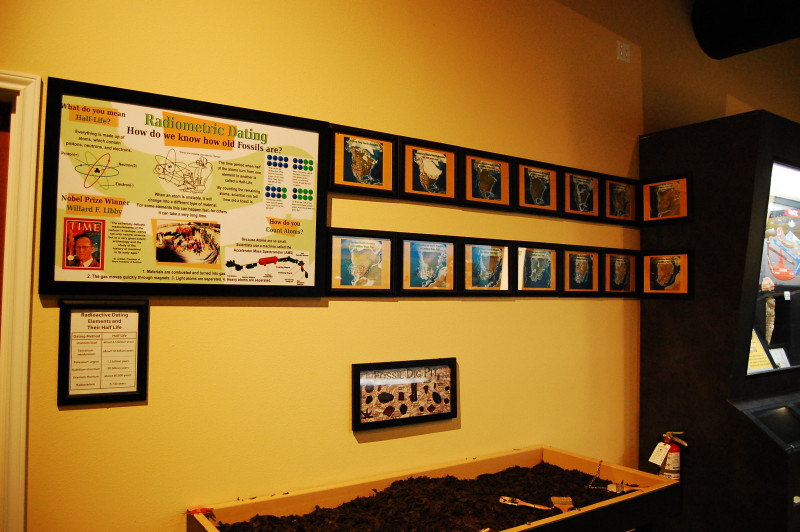
Radiometric Dating and Cretaceous North America
Radiometric dating is a process used to date rocks and fossils after they are found. Willard F. Libby was one of the first men to understand and discover this process. He won the Nobel Prize in 1960 for his work with radiometric dating.
During the Cretaceous Period, 75 million years ago dinosaurs were the dominant creatures that roamed the earth. Why are there limited dinosaur fossils in Texas? During that time most of East Texas was covered by the ocean. The fossils that we find from the Cretaceous period are from creatures that lived in the oceans.
Explore like a Paleontologist! You and your children may use the brushes to find replica fossils of actual museum fossils.
Fossilized Dinosaur Eggs & Hadrosaur Bone
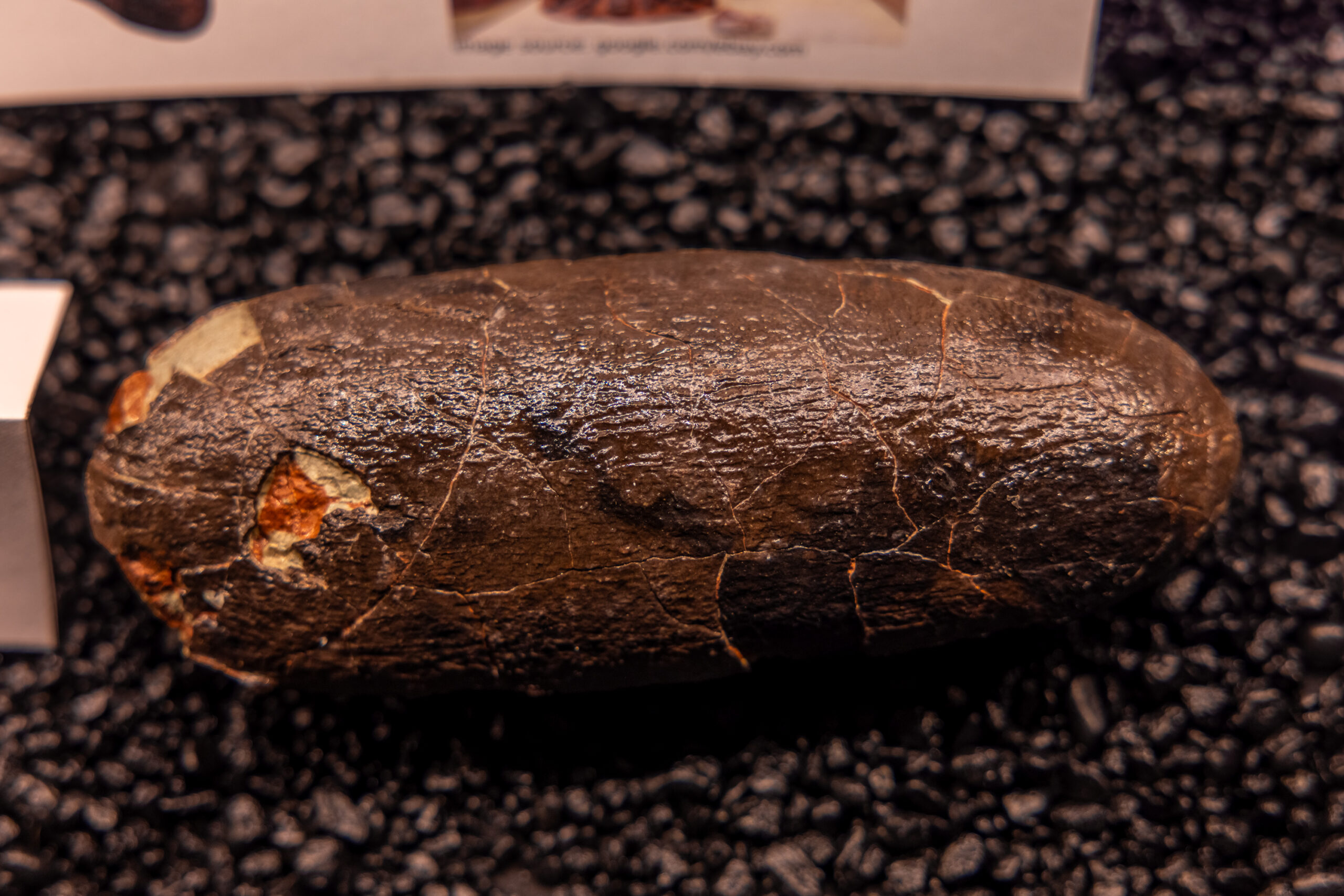
These are different fossilized dinosaur eggs that have been found. Through the X-Rays you can still see fossilized embryos inside the eggs.
These are fossilized Hadrosaur bone that has teeth marks in them from a Pterodactyl